
Without a doubt, this is the most frequently asked question TrustedCare's team of Care Advisers come across.
Routinely, people come to TrustedCare with the belief that they need a Nursing Home for their loved one. Our Advisers always respond to this statement with "Tell me a little bit more about your loved one?"
By delving a little deeper into loved ones' care needs, it becomes apparent that their care needs could comfortably be supported within a residential Care Home, as opposed to a Nursing Home.
Why does this matter, how different can they really be?
The most significant difference between a care home and a nursing home is the care needs that can be supported in each setting and the knock-on effect this has on the cost of care.
The difference in cost between a Care Home and Nursing Home can be upwards of £500 per week.
So let’s cut to the chase and define the difference between a Residential Care Home & a Nursing Home:
Residential Care Home: Care is provided 24 hours a day by trained Care Assistants. Commonly, residents are elderly, and their need for care is often due to degenerative health conditions associated with ageing, such as reduced mobility.
Nursing Home: Care is provided 24 hours a day by Registered Nurses who are supported by Care Assistants. All residents require some element of nursing care, such as the administration of intravenous medication and/or wound care; these are just a few possible reasons why 24-hour nursing care would be required.
Typically, nursing home costs are higher than those of a residential care home. The reason for this is that generally the needs of the individual are greater and as such require additional staff, facilities and resources to support complex care requirements.
If you have nursing needs, then it is likely that there will be a number of healthcare professionals already involved in your care. A Social Worker, Registered Nurse and Doctor will all be able to inform you of whether your care needs should be supported within a nursing home or a residential home.
If an individual has been granted Funded Nursing Care (FNC), they can only be admitted to a nursing home, not a residential care home, even if their care needs are relatively low at the time. FNC is a contribution made by the NHS towards the nursing costs of an individuals care needs, this can only be paid to a nursing home with a Registered Nurse, find out more about FNC here.
My Grandfather has dementia. Does he require a nursing home or a residential care facility?
This is not a simple ‘yes’ or ‘no’ answer. It entirely depends on your Grandfather’s additional care needs.
If your Grandfather simply shows signs of confusion and forgetfulness, then it is likely his care needs could be supported within a Residential Care Home. Not all Residential Care Homes support people with Dementia, but there are plenty that do. When shortlisting Care Homes, you just need to confirm that they support people with Dementia before taking your enquiry any further.
Many people with dementia present symptoms other than confusion; it is a good idea to consider the two questions below. Depending on whether you answer ‘yes’ or ‘no’, it impacts whether your Grandad requires a Care Home or a Nursing Home.
1. Is he prone to wander?
NO: Residential Home who support people with dementia
YES: Residential Home with secure Dementia Unit
2. Has he ever shown signs of verbal or physical aggression?
NO: Residential Home who support people with dementia
YES: Residential Home with EMI Dementia Unit or Nursing Home with EMI Dementia Unit
EMI stands for Elderly Mentally Infirm and normally describes people living with advanced stages of dementia. Care staff are trained to support individuals with challenging behaviour.
The individual’s behaviour and care requirements determine whether they require EMI care within a Residential Home or a Nursing Home. Within a Nursing Home, there should be specialist Mental Health Nurses on hand to support residents with advanced dementia who are able to administer medication.
If you have another healthcare condition which requires nursing care, as well as advanced dementia, then you will be best supported within an EMI Nursing Home. Additional care needs which would require nursing care include being bed-bound; if you are bed-bound, then you are at a higher risk of developing other health complications and therefore require the care of a Nurse.
My Mum has poor mobility. Does she need a nursing home or a care home?
This completely depends on your Mum’s level of mobility.
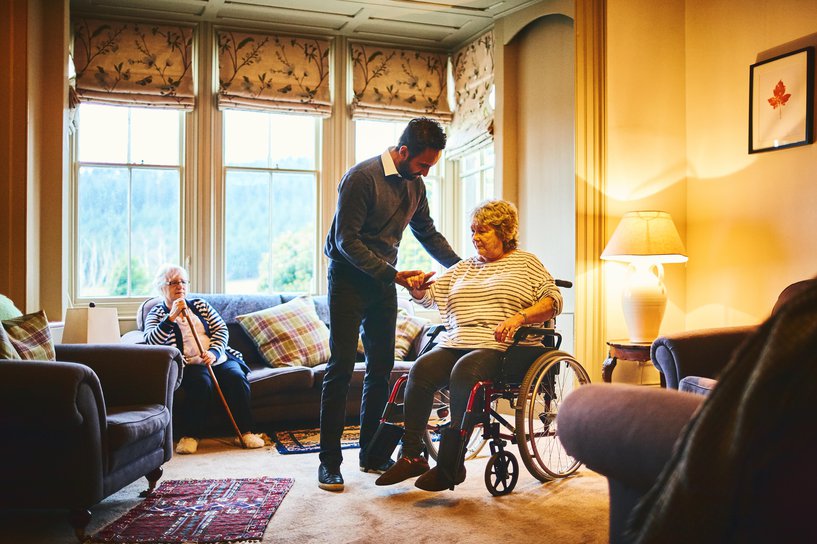
If your Mother is slow, requires the assistance of one and uses a stick or walking frame, it is likely that her care needs could be supported in a residential care home.
If your Mother is completely immobile and is either bed-bound or requires hoisting to transfer from bed to chair, it is likely that her care needs are nursing. If they are not nursing now, the more immobile she becomes, the more likely her care needs will tip into nursing.
Immobility is a nursing need because the level of care and assistance your Mother requires increases. It is also more likely that she will develop pressure sores, which will require monitoring and treatment from a Registered Nurse.
If you need support shortlisting either a Care Home or Nursing Home then contact TrustedCare for free, help and advice 7-days a week
Call us on 01865 680331
Send message